

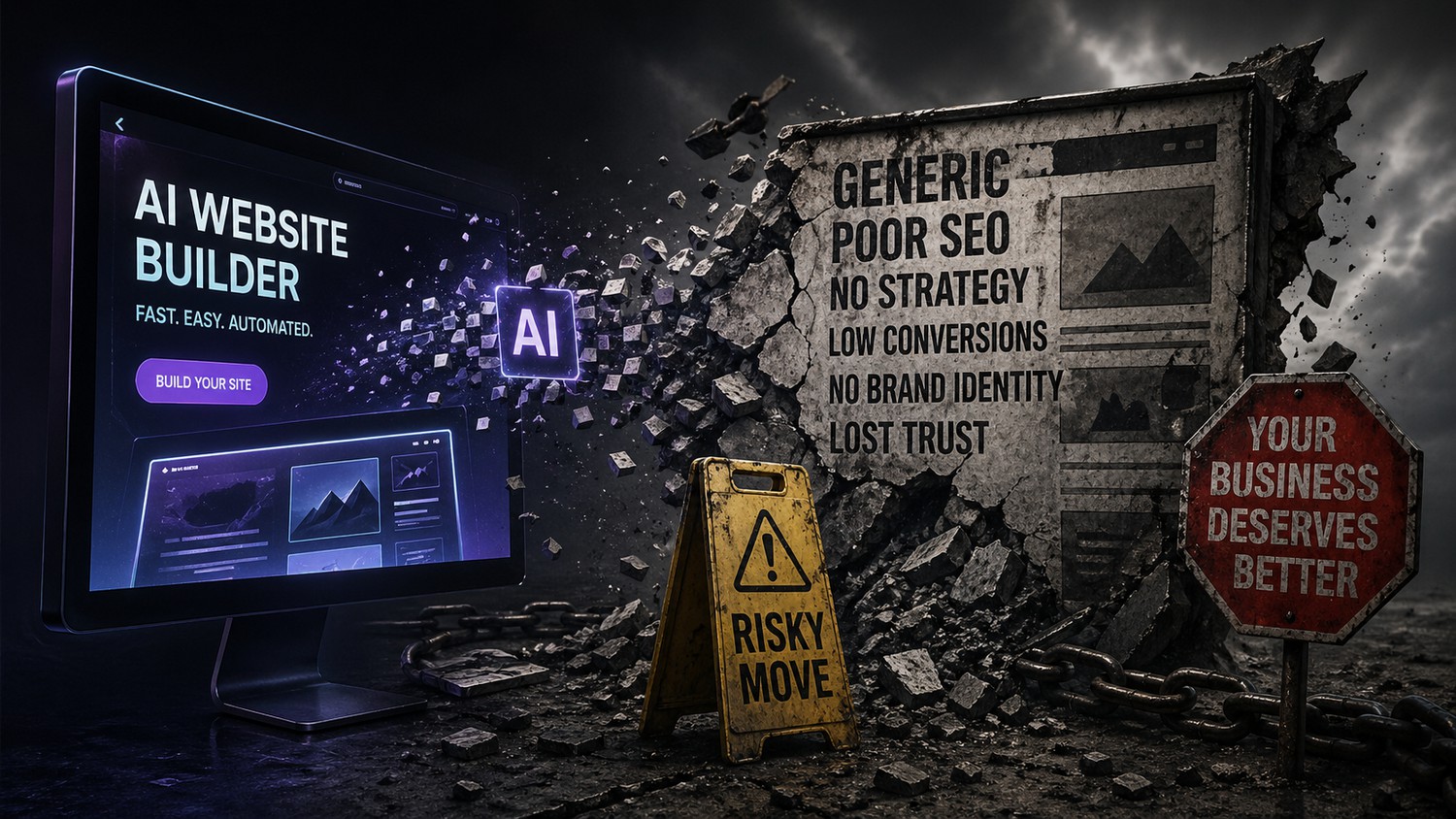
Why Relying on AI to Build Your Business Website Is a Risky Move
Artificial intelligence has rapidly become one of the most talked-about tools in modern business. From content generation to automation, AI promises speed, efficiency, and cost savings. It’s no surprise that many business owners are now turning to AI website builders and AI-generated content as a quick way to get online.
At first glance, it sounds like a no-brainer: faster builds, lower costs, and minimal effort. But when you look deeper, relying heavily—or entirely—on AI to build your website can create serious long-term problems for your business.
Let’s break down why.
The Illusion of “Fast and Easy”
AI tools are marketed as a shortcut: type in a few prompts, click a button, and your website is ready. While that might technically be true, what you get is often a generic, surface-level version of a real website.
A business website isn’t just a collection of pages—it’s a strategic asset. It needs to:
- Reflect your brand identity
- Speak directly to your ideal customer
- Guide visitors toward conversion
- Align with your long-term business goals
AI doesn’t truly understand your business. It predicts patterns based on existing data. That means your “custom” site is often just a remix of what already exists online.
Fast? Yes. Strategic? Not even close.
Generic Content That Blends In (and Gets Ignored)
AI-generated content tends to sound polished—but also predictable. It often:
- Uses repetitive phrasing
- Lacks real-world insight
- Avoids strong opinions or positioning
- Misses emotional connection
In competitive industries, sounding like everyone else is a serious disadvantage.
Your website should differentiate you. It should communicate why you’re better, different, or more trustworthy. AI struggles with that because it doesn’t have real experience, customer feedback, or a deep understanding of your niche.
The result? A website that looks fine—but fails to convert.
Weak SEO Foundations
AI can generate content with keywords, but SEO is far more complex than inserting phrases into paragraphs.
Effective SEO requires:
- Strategic keyword targeting based on intent
- Internal linking structures
- Technical optimization (speed, schema, indexing)
- Content depth and topical authority
- Ongoing analysis and refinement
AI tools often produce content that looks optimized, but lacks real search performance. In fact, over-reliance on AI content can lead to:
- Thin or low-value pages
- Duplicate or overly similar content
- Poor ranking performance
- Potential penalties if quality is too low
Search engines are getting better at identifying content that doesn’t provide real value. If your entire site is AI-generated, you’re taking a gamble with your visibility.
No Real Strategy Behind the Build
A high-performing website is built with intention. Every section, page, and call-to-action serves a purpose.
AI doesn’t think strategically—it responds to prompts. That means it can miss:
Proper user journey flow - AI can do smart things, but it often fails at creating a logical and clear path to take people from visitor to client.
Conversion-focused design - AI will often build a nice-looking website for <insert industry here>, but not consider industry- or visitor-specific calls-to-action. When it comes to CTAs, one size does NOT fit all. Wrong CTA means no action.
Sales funnel integration - AI will generally have no clue if you use a sales funnel or CRM, let alone which one, or how to integrate the website it builds with it. Human designers ask these questions and build accordingly.
Audience-specific messaging - Much like "Conversion-focused design" above, AI doesn't know or understand your industry or audience. Remember that AI is only regurgitating an average of all the data out there. It's not "thinking", "making decisions", or "giving you new information", it's just a big melting pot for "average".
Competitive positioning - AI cannot, not "it does not", but it cannot position your website in a more competitive manner than your competition. By the very nature of how AI works (read/reread above under "Audience-specific messaging), AI will, most likely, automatically position you in a far worse position than an average human writer with few skills.
For example, a contractor’s website should guide users from trust-building (reviews, projects) to action (quote request). AI might include those elements—but not in a way that actually drives conversions.
Without a strategy, your website becomes a digital brochure instead of a lead-generating machine.
Design Limitations and Lack of Brand Identity
AI website builders typically rely on basic templates. While they may look modern, they often lack:
True customization - if you're unhappy with the look, customization is often difficult if available at all.
Unique visual identity - Because AI is just averaging existing content, you will see elements that look similar (or perhaps even exactly like) your competition. Again, you're not differentiating yourself from everyone else.
Industry-specific design nuance - Just as not all web designers are the same, not all plumbers, or mechanics, or whatever industry you're in are the same. But you are asking AI to build you a website based on all your competitors' websites.
Consistency with your branding - Even if you give it colors and font styles, AI isn't going to give you true, consistent branding that is compatible with all your other visual products.
Your brand is more than colors and fonts—it’s how your business is perceived.
A cookie-cutter design sends the wrong message, especially in industries where trust and credibility matter. Visitors can often tell when a site feels “templated” or mass-produced, even if they can’t explain why.
That subtle lack of authenticity can cost you leads.
Inaccuracies and Misinformation
AI doesn’t “know” facts—it predicts likely answers. That means it can (and often does, really often) generate incorrect or misleading information.
On a business website, that’s a serious issue.
Examples include:
- Incorrect service descriptions
- Misstated capabilities
- Wrong legal or compliance details
- Outdated or irrelevant information
Even small inaccuracies can damage trust. And if you’re in industries like construction, healthcare, finance, or legal services, errors can have real consequences.
Every piece of AI-generated content needs human review—and at that point, you’re no longer saving as much time as you thought.
Although we utilize AI as a tool in the process, the last thing that we do is fully and comprehensively read through all generated content, and we will heavily edit and word-smith it before ever letting it loose on the internet. Without this step, your content will sound robotic and like everyone else.
No Competitive Edge
If you’re using AI to build your website, there’s a good chance your competitors are too. And that creates a problem: everyone starts to look and sound the same.
AI pulls from existing data, which means it reinforces what’s already common in your industry. It doesn’t innovate—it averages.
Businesses that stand out online do the opposite.
- Take clear positions
- Speak directly to specific audiences
- Showcase real expertise and personality
- Build trust through authenticity
AI struggles to do any of those at a high level.
Limited Scalability and Growth
Your website shouldn’t just work today—it should grow with your business. AI-generated sites often lack the structure needed for long-term expansion, such as:
- Content silos for SEO growth
- Scalable page architecture
- Advanced integrations (CRM, automation, analytics)
- Custom functionality
As your business evolves, you may find yourself needing to rebuild or heavily modify your AI-generated site. What seemed like a shortcut can quickly become a bottleneck.
Overreliance Creates Dependency
One of the biggest hidden risks of AI is dependency. If your entire website is built and maintained by AI tools, you may:
Lose control over messaging - controlling your overall brand message can be tough if you don't understand website design and how AI integrates into that process.
Struggle to make strategic updates - As mentioned above, like your business, a website needs to be continually evolving. AI-designed websites can be difficult to incorporate new content into or to make critical changes.
Become reliant on specific platforms or tools - Without specific website design knowledge, business owners can become trapped in using the same limited tools, which don't necessarily cover options your business may need going forward.
Lack of understanding of your own digital presence - Let's face it, you know your business, but you didn't go into business to design websites. Like your business, website design takes knowledge and skill. If you don't have these skills, it can cost you. Are you prepared to take the time out of your business to learn them and remain current?
A strong business should own its brand, voice, and online strategy—not outsource it entirely to algorithms.
Where AI Does Make Sense
To be clear, AI isn’t the enemy. It’s a tool—and like any tool, it’s powerful when used correctly. AI can be incredibly helpful for:
- Brainstorming ideas
- Drafting initial content
- Speeding up repetitive tasks
- Assisting with research
- Generating outlines
But it should support human expertise—not replace it. The best websites today are built with a combination of:
- Strategic thinking
- Professional design
- Experienced copywriting
- Technical SEO knowledge
- Selective use of AI tools
That balance is what creates real results.
The Bottom Line
Relying on AI to build your business website might save time upfront—but it often costs you in performance, credibility, and growth.
Your website is one of your most important business assets. It represents your brand, generates leads, and shapes how customers perceive you.
Cutting corners here isn’t just a technical decision—it’s a business decision.
If you want a website that actually drives results, it needs more than automation. It needs strategy, experience, and a human touch that AI simply can’t replicate.
Final Thought
AI will continue to evolve, and its role in web development will grow. But businesses that treat it as a complete replacement for human expertise will struggle to stand out.
The companies that win online won’t be the ones using AI the most—they’ll be the ones using it wisely.
And when it comes to your website, “wise” means using AI as a helper. AI is NOT an autopilot or magician that will magically build a great website without significant input from you now and in the future.