

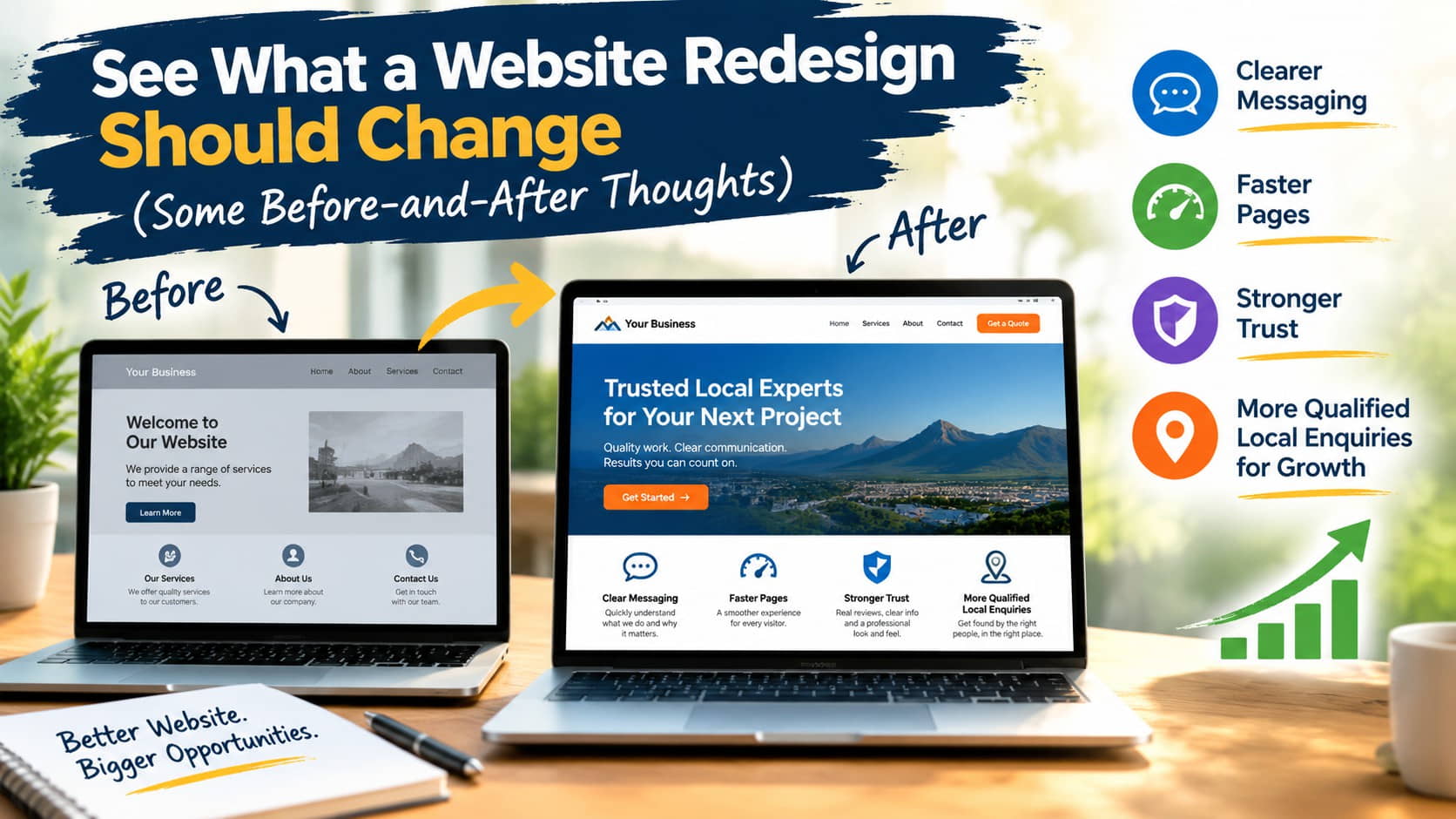
A website redesign before-and-after comparison should show more than a new colour palette and larger photos. For a small business, the real change is whether a visitor can quickly understand what you do, trust you, and take the next step. If the redesigned site looks sharper but still leaves people hunting for services, prices, locations, or a way to get in touch, it has missed the point.
A good redesign turns a website from a digital brochure that exists because it “should” into a working part of your sales process. That might mean more phone calls for a trades business, more quote requests for a consultant, or more bookings for a local clinic. The right result depends on your business, but the website should make that result easier to achieve.
What a Website Redesign Before and After Should Reveal
The most useful before-and-after view starts with the problems behind the old site. Perhaps it was built years ago, loads slowly on mobile, has an outdated logo, or relies on vague language such as “quality service you can trust”. These are common issues, but they affect real customer decisions.
Before a redesign, many websites make visitors do too much work. The homepage may lead with a large image but no clear offer. Important services may be buried in a menu. Contact details may be hard to find, especially on a mobile phone. A customer who is ready to act is not likely to spend ten minutes figuring things out. They will usually return to search results and choose a competitor that feels clearer.
After a well-planned website redesign, the page structure has a job. The headline states the service and who it is for. Supporting copy answers the obvious questions. Calls to action appear where a visitor is likely to need them, not just in a tiny button at the bottom of the page. Real customer reviews, project photos, qualifications and service-area details provide reassurance at the point of decision.
And don't forget a staff directory, especially for service industires who visit customers' homes. Knowing the face of the person who will be visiting to complete the work provides HUGE trust signals for potential customers! Name, position, a quality image, and a brief bio help people get to know your team.
That is why the best website redesign before-and-after examples focus on business outcomes alongside appearance. A clean visual design helps, but clarity, speed and credibility are what give the design commercial value.
The Changes Customers Notice First
Most business owners look first at the visual transformation, and that is reasonable. An old site can make a capable business look less established than it really is. Modern typography, professional imagery and consistent colours can immediately create a stronger first impression.
Customers notice something even more valuable, though: ease of use. They should be able to tell within seconds whether you are relevant to their problem. A Phoenix air conditioning company, for example, should not make someone guess whether it handles emergency repairs, installations and/or maintenance. A visitor should see those services quickly and know how to request help.
Mobile usability is part of this. Many local service enquiries begin on a mobile phone, often between errands, at a worksite or after a problem has appeared. Buttons need to be easy to tap, forms need to be short enough to complete, and phone numbers should be visible without forcing people to zoom or scroll through a wall of text.
A redesign also gives you a chance to remove distractions. Pop-ups, stock imagery that says nothing about the business, long introductions, and too many competing buttons can all dilute the message. More content is not automatically more useful. The goal is to give customers the information they need in the order they need it.
A Better Website Starts With Better Questions
Redesign projects go wrong when they begin with, “What style do we want?” Style matters, but it comes after strategy. Start by asking what the website needs to do for the business over the next year.
For some companies, that means generating more qualified leads. For others, it means reducing time spent answering the same questions over the phone. A business with a strong referral network may need a site that validates its reputation when people look it up. An expanding company may need pages that support new services or locations without rebuilding the whole site later.
It also helps to look at your current evidence. Which pages receive traffic? Which services bring the best customers? Are people abandoning the contact form? Do calls tend to come from mobile users? Even limited data can expose gaps between what your business wants to promote and what visitors can actually find.
A practical website redesign should define a primary action for each key page. On a service page, that may be requesting a quote. On a page for a high-consideration service, it may be arranging a consultation. On an information page, it could be calling the business. Trying to make every page do everything usually creates confusion.
The Work Behind the Visible Before and After
The polished homepage is only one part of a proper redesign. Much of the work customers never see is what makes a site more reliable and easier to manage after launch.
Performance is a good example. Large uncompressed images, unnecessary plugins, and outdated code can make pages sluggish. Faster loading will not solve a weak offer, but a slow site can waste the opportunity created by good marketing. It also affects how professional the business feels. When a page stalls, confidence drops.
Search visibility deserves the same care. Redesigning without preserving useful page content, page titles, service information, and redirects can cause avoidable losses in search traffic. A new site should improve on-page SEO while protecting the foundations that are already working. If you serve a local area, clear service pages, accurate business details and useful local relevance often matter more than adding generic keyword-heavy copy.
Security, hosting and updates are also part of the after picture. A website is not finished simply because it has launched. Software needs monitoring, backups need checking, and content needs updating as services, staff, offers, and customer questions change. A site that looks current on launch day can become outdated before example surprisingly quickly without ongoing support.
Avoid Redesigning for the Wrong Reasons
Sometimes a redesign is necessary. Sometimes the existing site needs focused improvements instead. If your website has a clear message, converts well, and is technically healthy, replacing everything may not be the best use of budget. Improving a weak service page, adding better proof, simplifying the enquiry process or refreshing mobile layouts could create a worthwhile result with less disruption.
On the other hand, piecemeal fixes have limits. If the site is difficult to update, built on unsupported technology, inconsistent across pages or disconnected from your current brand, patching it may cost more over time than rebuilding it properly.
Be careful with trends, too. A design that looks fashionable can date quickly. Small businesses usually benefit more from clear navigation, readable text, genuine photos, and obvious contact options than from elaborate animation. Motion and visual effects can add personality when used carefully, but they should never delay the content or hide the message.
How to Judge Whether the Redesign Is Working
Do not wait until the end of the year to decide whether the new site helped. Set a few practical measures before launch, then review them consistently. The right measures vary, but they may include form submissions, phone calls, booked consultations, page speed, ranking visibility for important services, and the quality of leads coming through the website.
Quality matters as much as volume. Ten enquiries from people who understand your service and have the right budget can be far more valuable than fifty vague messages. Better content and clearer qualification can reduce low-fit enquiries while helping serious customers feel ready to contact you.
Ask your team what has changed as well. Are customers arriving with better questions? Are they finding the right service before they call? Is the team spending less time correcting basic misunderstandings? These observations often reveal the value of a redesign before analytics has gathered enough data to show a long-term pattern.
A website should not become another task on your already crowded list. That is why a managed approach can make sense for busy business owners. CitrusKiwi combines the redesign process with ongoing updates, hosting, monitoring and support, so the site can keep up with the business rather than being left behind after launch.
The best "after" result is not simply a website that earns compliments. It is a site that gives the right customer confidence to get in touch, gives your team a more useful sales tool, and remains easy to improve as your business grows.