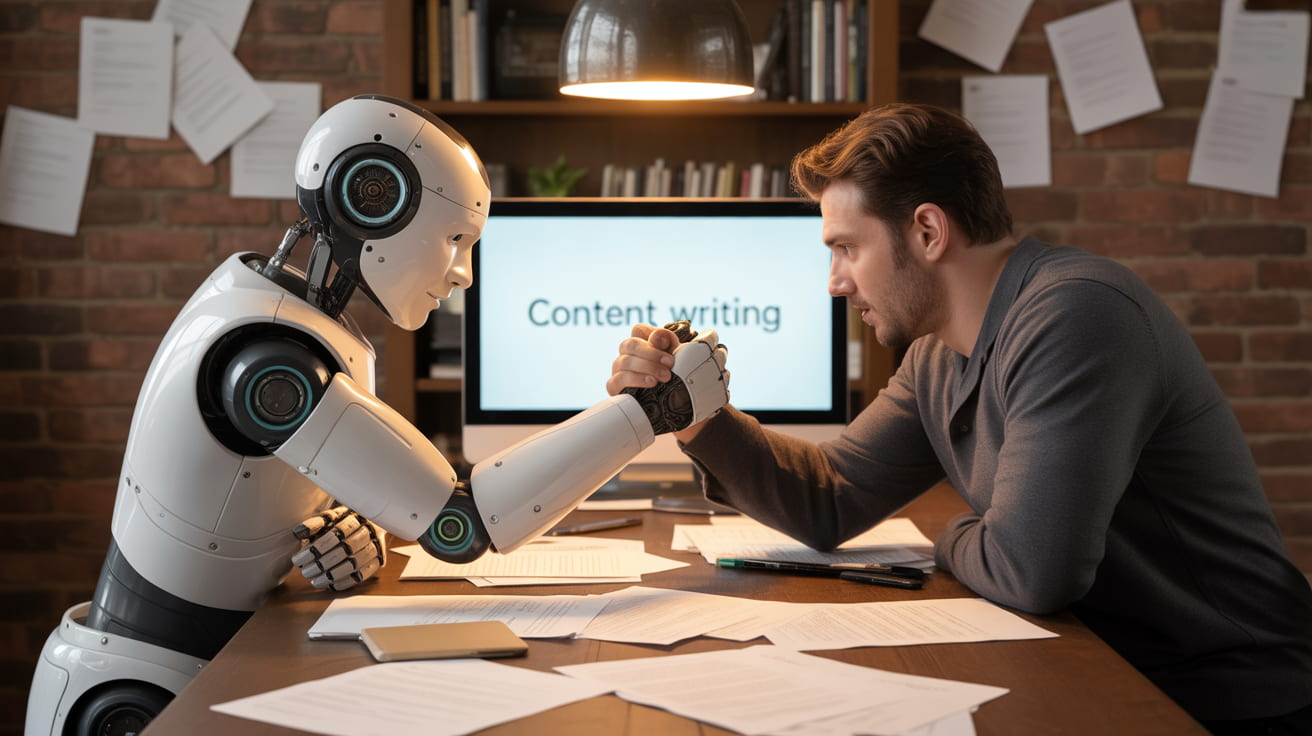
AI vs. Human: The Honest Truth About Writing & Web Design
Everyone's picking sides. Let's actually look at both.
If you've spent any time online lately, you've probably noticed that everyone has a hot take on AI. Either it's about to replace every writer and designer on the planet, or it's a glorified autocomplete that'll never beat human creativity. The truth? It's messier — and more interesting — than either camp wants to admit.
Let's break it down honestly. We're looking at two extremes: writing or designing a website entirely with AI, and doing it entirely by hand. No hybrid, no "use AI as a tool" — pure one-or-the-other. Here's what each approach actually looks like in the wild.
Going Full AI: What You Actually Get
Firing up an AI tool and asking it to write your homepage copy or generate a full website layout is genuinely impressive the first time you do it. Within seconds, you've got something that looks… complete. Structured. Almost professional. And for a lot of use cases, that's exactly what you need.
The real strengths of AI-only creation
- Speed. A full landing page draft in 90 seconds isn't an exaggeration anymore.
- Consistency. AI doesn't have bad days. The tone stays even across 50 pages.
- Volume. Need 30 product descriptions? Done before lunch.
- SEO basics. AI nails structure — headings, keyword placement, meta descriptions.
- No blank page paralysis. There's always something to start from.
- It sounds like everyone else. AI pulls from the average of everything it's seen. Average = forgettable.
- No lived experience. It can't write from your brand's actual story or a customer's real moment.
- Design homogeneity. AI-generated layouts follow patterns. Visitors feel them subconsciously.
- Hallucinations. Stats, quotes, and "facts" still need fact-checking.
- Zero intuition. It doesn't know when to break the rules because the rules won't work here.
The deeper issue with going full AI on web design, specifically, is what you might call the "competence trap." The output is always acceptable — and acceptable is the enemy of memorable. You end up with a site that passes every technical check and fails every emotional one. Users don't bounce because something is wrong. They bounce because nothing feels right.
"AI can write you a website that checks every box and crosses every T. It just can't write you one that makes someone stop scrolling because they felt something."
Going Full Human: The Other Side of the Coin
Before we get nostalgic, let's be real: writing and designing everything manually has its own set of very real problems. The romantic image of a lone creative genius crafting perfect prose doesn't survive contact with a deadline and a 40-page website.
What humans genuinely do better
- Voice. Real personality, real point of view, real humor that doesn't feel algorithmic.
- Cultural nuance. A human knows when a joke lands, when it doesn't, and why.
- Originality. Genuine creative leaps come from actual lived experience.
- Trust signals. Readers can often sense authenticity — and its absence.
- Design intuition. Breaking the right rules at the right moment is a human skill.
- Time. Good writing is slow. Great web design is slower.
- Inconsistency. Mood, energy levels, and creative blocks are all factors.
- Cost. Skilled writers and web designers aren't cheap — nor should they be.
- Scaling is painful. 50 product descriptions written by hand is a brutal week.
- SEO blind spots. Many strong writers don't naturally think in keywords and structures.
The scalability problem is where manually-only approaches genuinely collapse. A single brilliant writer can produce incredible work — but when a business needs consistent, high-volume content across dozens of channels, human-only production hits a wall fast. It's not a character flaw; it's physics.
Head-to-Head: The Honest Scorecard
| Category | Full AI | Full Human | Edge |
|---|---|---|---|
| Speed & volume | Instant, unlimited | Slow, limited | AI wins |
| Authentic voice | Generic, averaged | Distinctive, personal | Human wins |
| Technical SEO structure | Strong | Often overlooked | AI wins |
| Emotional resonance | Simulated, flat | Genuine, layered | Human wins |
| Design originality | Pattern-reliant | Rule-breaking capable | Human wins |
| Factual reliability | Needs verification | Accountable, researched | Human wins |
| Cost at scale | Near-zero marginal | Linear cost increase | AI wins |
| Consistency across pages | Uniform | Variable | Tie (context-dependent) |
| Cultural sensitivity | Hit or miss | Contextually aware | Human wins |
The Part Nobody Talks About: What AI Gets Wrong in Design
Here's where it gets specific. AI tools for web design — whether that's code generation, layout suggestions, or copy — have some pretty consistent failures that are worth knowing before you go all-in.
The hierarchy problem. AI-generated layouts tend to treat everything as equally important. Real design is about directing attention — this first, then that. AI rarely knows what your business actually wants users to do, so it defaults to balance when it should be creating tension.
The whitespace blindspot. Great design is often about what you don't put on the page. AI fills space. It adds. It completes. The discipline of restraint — the strategic empty section, the short paragraph that breathes — is something most AI tools actively work against.
The "sounds like a press release" problem. Ask any AI to write "About page" copy, and you'll get something that begins with "We are a passionate team dedicated to delivering exceptional solutions." Nobody talks like that. Nobody connects with that. AI learned from the web, and the web is full of copy nobody actually likes. (Psst! We wrote our "About Page" based on Simon Sinek's brilliant "Start with why" strategy)
What AI won't admit to. This is perhaps the most critical deficiency in relying on AI to write your content. In fact, it probably should be the #1 reason why AI-only driven content can sink you. AI does not like admitting it doesn't know the answer. In fact, it doesn't even like saying "This data may not be completely accurate." Many times, it will make up information, or give you skewed data. This is why we cannot stress enough that human intervention is a must.
It uses someone else's content to build yours. To a far greater extent than humans, AI sources the basis for the article or website it's designing from someone else's website. It can't "create" in the purist meaning of the word. It does collate, concatenate, and organize, but it does not dream up new ideas. It just reassembles old ones. Are those old ideas wrong? It happily writes you an article that's wrong!
So What's the Actual Takeaway?
If you're forced to pick one — and the whole premise here is that you are — the answer depends almost entirely on what you're optimizing for.
If you need volume, speed, and technical correctness, AI wins on pure efficiency. You'll sacrifice some soul, even perhaps some data accuracy, but you'll ship. For e-commerce product pages, FAQ sections, basic informational content, and structural web scaffolding, going AI-first is a defensible and often smart choice.
If you need trust, memorability, and genuine differentiation, the human approach holds ground that AI hasn't figured out how to take yet. Brand storytelling, thought leadership, high-stakes landing pages, anything where a real human decision is at stake — these still benefit enormously from a real human voice behind them.
The uncomfortable truth is that a website built entirely by AI will probably rank okay, load fast, and look fine. And a website written entirely by hand, without any of the structural and SEO discipline that AI enforces, might be beautiful and invisible. Neither extreme is actually winning. (See How we combine them below)
"The goal was never AI or human. The goal was always the reader."
The moment you stop thinking about which tool is better and start thinking about what the person on the other side of the screen actually needs — that's when the two can work together harmoniously. Whether you use AI, your own hands, or both is just the method. The intention is what shows.
The Real Bottom Line
At least now and for the foreseeable future, AI-only generated content or websites just can't cut it against humans. Yes, humans are slow compared to AI, but they impart feeling, context, and a comparative thinking that AI just does not have.
AI is a tool, just like a pen. Use it to its limits, use it to save time, to build a framework. Just don't rely on it to do the whole job. Or you'll end up with generic content that search engines may like, but readers will, by-and-large, navigate away from!
The CitrusKiwi Approach to AI Usage
AI is a great tool that leverages the power that computers offer to streamline many processes. We use it in many aspects of website design, and content creation. However, it's very much a "trust, but verify" kind of relationship.
We write content for businesses that we know little about. It sounds and looks good, but we never publish it before doing serious "human-based checking". This involves us looking over the article for poor grammar and construction, as well as obvious mistakes. Then we forward to the client for their input. Once these checks are completed satisfactorily, we will publish the new content.
"You cannot afford to trust AI 100% to write your content or build your website!"