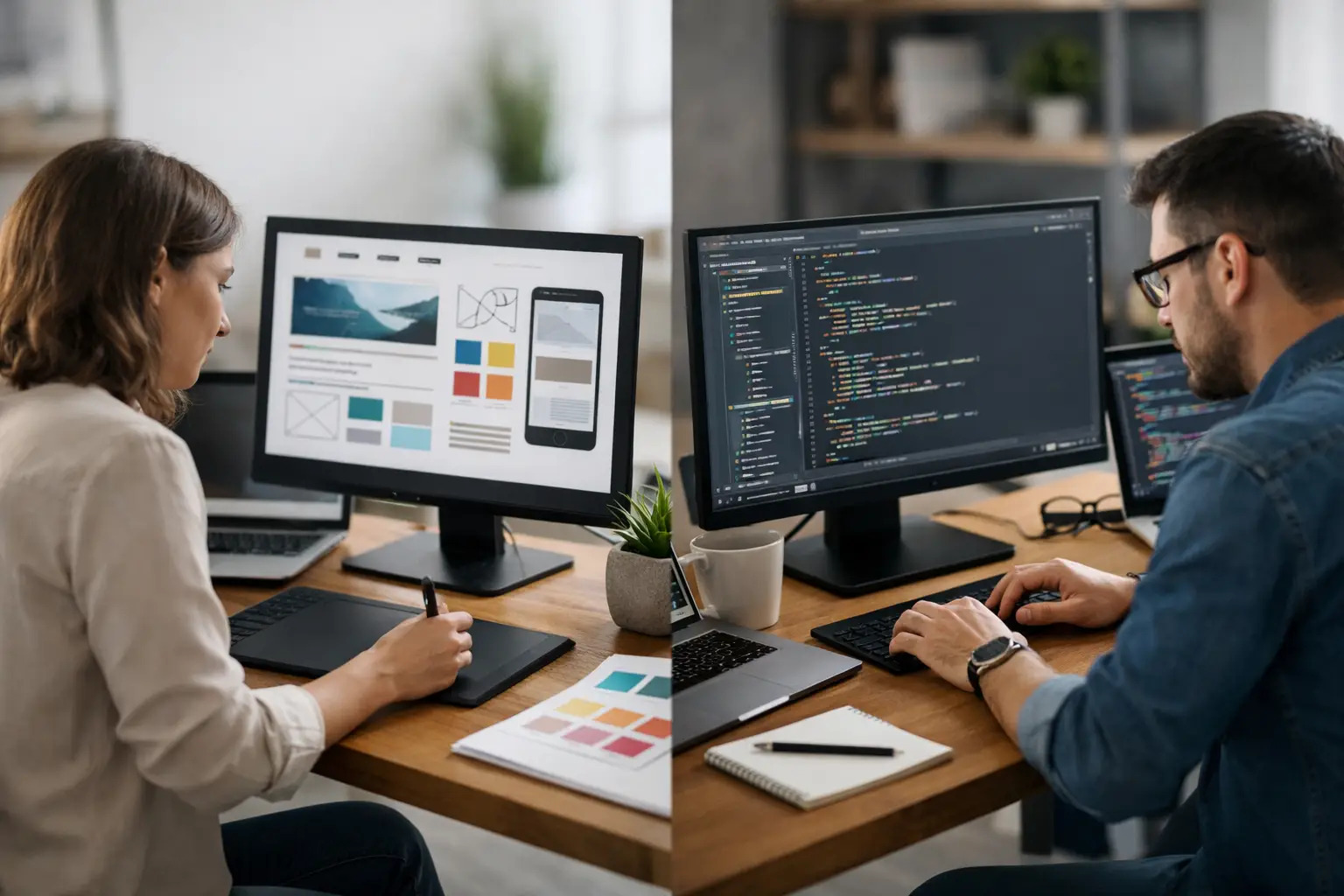
If you have ever asked for a new website and got pulled into a conversation about layouts, code, hosting, and user experience, you have already run into the difference between web design and web development. Most small business owners do not need a technical lecture on it. They need to know who does what, why it matters, and what they are actually paying for.
That matters because plenty of website problems start with crossed wires. A business owner thinks they are hiring someone to "build the site", but the person they hire is really focused on visuals only. Or they hire a developer who can code complex features, but the site still looks dated or confuses visitors. The result is a website that may exist, but does not do its job.
What is the difference between web design and web development?
Web design is about how a website looks, feels, and guides people to take action. Web development is about how the website is built, how it functions, and how it performs behind the scenes.
Design covers the customer-facing experience. That includes page layout, colours, fonts, mobile responsiveness, calls to action, image use, and the overall flow from one section to the next. A designer is thinking about first impressions, trust, readability, and whether a visitor can quickly find what they need.
Development is the technical side that turns those ideas into a working website. That includes writing code, building templates, setting up forms, integrating tools, improving speed, fixing errors, and making sure the site runs properly across devices and browsers. A developer is thinking about structure, functionality, performance, and long-term reliability.
In simple terms, design shapes the experience. Development makes it real.
Why small businesses often confuse the two
The confusion is understandable because both happen on the same website, often at the same time. If you are a plumber, med spa, lawyer, roofer, or local shop owner, you probably don't separate the site into creative and technical roles in your head. You just want something professional that loads fast, looks trustworthy, and gets enquiries.
The problem is that many providers specialise in one side more than the other. A freelance designer may produce beautiful mock-ups but struggle with ongoing technical support. A developer may build custom functionality but give less attention to messaging, branding, or conversion-focused layout. If you are not clear on the distinction, it is easy to assume all website providers offer the same thing. They do not.
That is why asking the right questions up front can save time and money. Are they helping with brand presentation and user experience? Are they handling the code, performance, maintenance, and updates as well? Those are not small details. They affect what you get after the site goes live, not just on launch day.
What web design actually includes
Good web design is not decorating a homepage. It is problem-solving.
A designer looks at how your business should appear online to earn trust quickly. For a service business, that might mean a clean homepage with a clear headline, easy-to-find contact details, strong review placement, and service pages that explain things without sounding vague. For a business with a more visual offer, it might mean a stronger image strategy and more emphasis on brand personality.
Design also deals with usability. If your phone number is buried, your forms are awkward, or your text is hard to read on mobile, the design is not doing its job. Plenty of websites fail not because the company is poor at what it does, but because visitors cannot easily take the next step.
A strong designer asks questions like: What does the customer need to feel in the first five seconds? Where should attention go first? What might cause hesitation? How can we reduce friction?
That work has a direct effect on leads. A better-looking website is nice. A better-converting website is better for business.
What web development actually includes
Web development is where the moving parts come together.
This is the work that turns the design into a functioning site. Developers build page structures, connect forms, set up content management systems, handle hosting environments, and make sure the site behaves properly across desktop and mobile devices. If the website has booking tools, custom calculators, member areas, or third-party integrations, development is what makes them work.
Development also affects the parts business owners usually only notice when they go wrong. Slow load times, broken pages, plugin conflicts, mobile glitches, and security issues are often development problems rather than design problems.
That is a big reason many businesses get frustrated after launch. The site may have looked fine in the proposal stage, but if no one is actively handling updates, security monitoring, bug fixes, and performance improvements, things start slipping. A website is not a printed brochure. It needs upkeep. Regularly!
Web design vs web development in the real world
Here is the practical difference.
If a visitor lands on your homepage and immediately feels that your business looks established, easy to work with, and relevant to their needs, that is largely design.
If that same visitor clicks through pages smoothly, submits a form without issues, views the site properly on mobile, and does not wait ages for it to load, that is largely development.
Of course, there is overlap. Designers should understand what is realistic to build. Developers should care about user experience. But they are not interchangeable roles.
Think of it this way: design helps people want to do business with you. Development helps them actually do it without friction.
Which one matters more?
For most small businesses, both matter, and the better question is whether the website is being managed as a full business tool rather than a one-off project.
A polished design without reliable development can leave you with a site that breaks, gets outdated, or becomes difficult to edit. Strong development without thoughtful design can leave you with a technically sound website that does not generate trust or enquiries.
If you had to choose where the bigger business risk sits, it depends on your current problem. If your site looks dated and weak compared with competitors, design may be the urgent issue. If your site already looks acceptable but loads slowly, gets hacked, or falls apart when updates are needed, development may be the bigger concern.
Most of the time, though, the real issue is not choosing one over the other. It is making sure someone owns both outcomes.
Why this matters when hiring a website provider
When a provider says they "do websites", ask what that includes after launch.
Do they handle revisions (we do!), or will every small change become an invoice (not with us!)? Do they manage security and software updates? Are they improving speed over time? Will they help refine content and page structure based on what is working? Are they building something that can grow with your business, or just handing over files and disappearing?
This is where many small businesses get stuck. They pay a lump sum for a build, then find themselves chasing edits, paying extra for basic changes, and dealing with separate vendors for hosting, SEO, maintenance, and troubleshooting. It creates cost and stress that never showed up in the original quote.
A managed approach usually makes more sense for busy owners because it treats design and development as ongoing responsibilities, not one-time tasks. That means the website can keep improving instead of ageing the moment it goes live. For many small businesses, that model is more practical than hiring a designer, a developer, a hosting company, and a marketing provider separately.
The best websites are not built in silos
A website works best when design and development support the same goal. Not awards. Not technical bragging rights. Results.
That means design should be shaped around what your customers actually need to see and do. Development should support speed, reliability, search visibility, and easy maintenance. If one side is disconnected from the other, the website tends to underperform even if parts of it look impressive.
This is especially true for local businesses competing in crowded markets. You do not need a complicated site for the sake of it. You need a website that looks credible, works properly, shows up well, and stays current without becoming another item on your to-do list. That is where having one dependable partner matters. Citrus Kiwi is built around that idea because small businesses usually need ongoing support, not just a handover.
If you are comparing providers, do not just ask to see their portfolio. Ask how they handle the full picture after launch. A website that looks good on day one is helpful. A website that keeps working for your business month after month is far more valuable.
The useful question is not whether you need design or development. It is whether your website has enough of both to help your business grow without creating more work for you.