A Phoenix plumber misses a call at 7pm. A homeowner searches on their phone, finds three local websites, and picks the one that loads quickly, explains the service clearly and makes booking easy. That decision happens in seconds. So, can AI build business websites that help a small business win that customer? Yes, but the more useful answer is: it can build part of one. It cannot reliably run the whole job without experienced human direction.
AI website tools are getting better at producing pages, writing starter copy, and suggesting layouts at impressive speed. For a business owner who needs something online quickly, that is genuinely helpful. But a website is not simply a collection of attractive sections. It needs to represent your business accurately, earn trust, work properly on every device, show up for relevant searches and keep improving after it goes live.
For most local service businesses, the question is not whether AI can make a website. It is whether the finished site will generate enquiries without creating another job for the owner.
What AI can do well when building a business website
AI is particularly useful at getting a website project moving. Give it a business name, industry, location and a few services, and it can suggest a homepage structure, produce initial service descriptions and create a usable visual direction. That can save hours compared with starting from a blank screen.
It is also useful for practical tasks behind the scenes. AI can help draft frequently asked questions, generate alternative calls to action, organise content ideas and spot obvious gaps in a page. A web professional can use those outputs to move faster and spend more time on the decisions that affect quality.
For a new business testing an idea, an AI-built starter site may be enough to establish a basic online presence. If your offer is simple, your market is not highly competitive and you are happy to handle updates yourself, it can be a sensible first step.
The limitation is that AI works from patterns and prompts. It does not visit your premises, understand how your team handles a difficult job or know which service is most profitable for you. It cannot tell the difference between a generic claim and the specific proof that makes a local customer choose your company.
Can AI build business websites that convert?
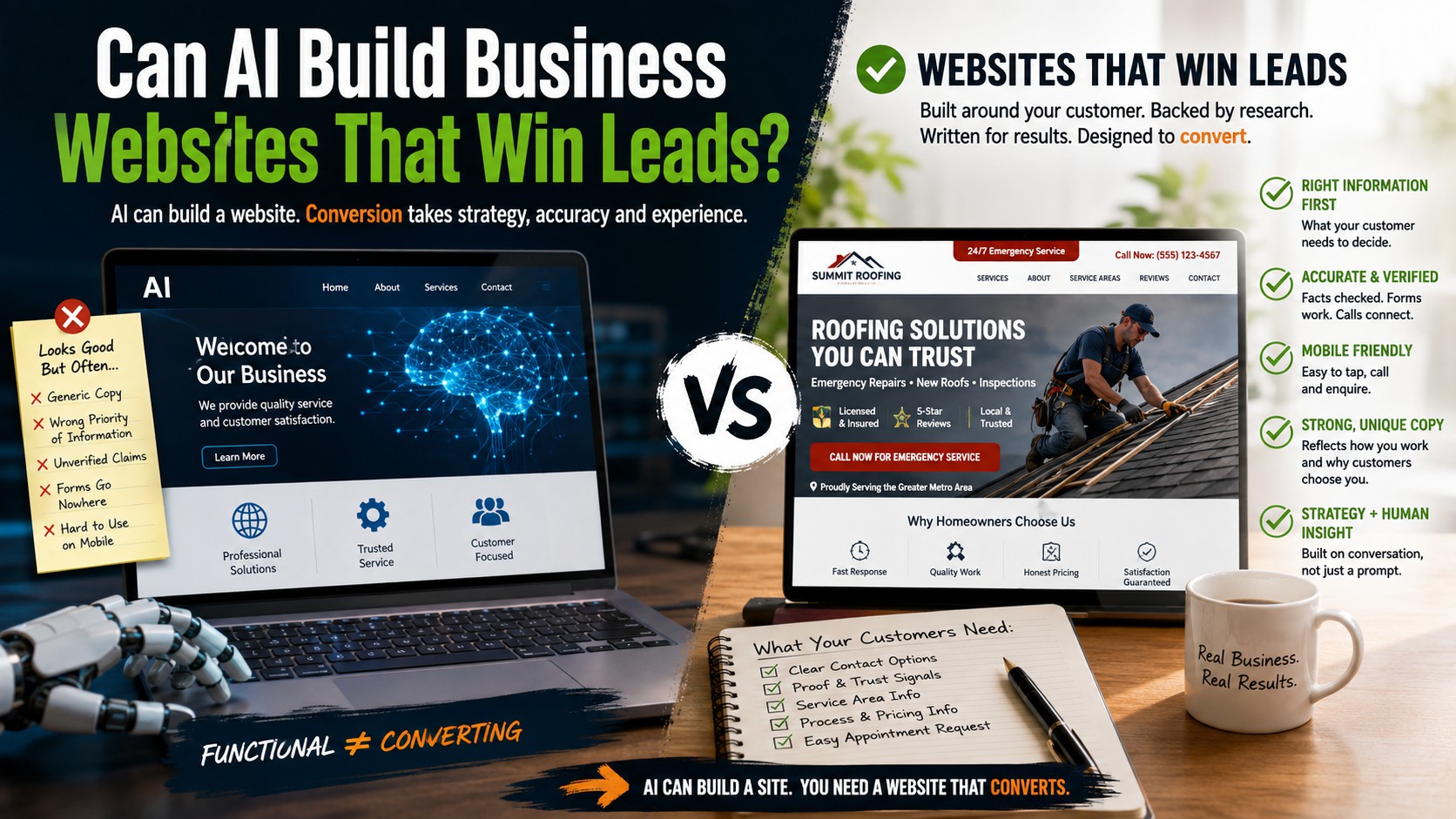
AI can create a functional website. Conversion is a different standard.
A converting website is built around what a customer needs at the moment they are deciding. A roofer may need clear emergency contact options, proof of insurance, and service-area information. A dental practice may need clinician credentials, treatment explanations and a calm way to request an appointment. A B2B provider may need to answer questions about process, pricing expectations and turnaround times before asking for a call.
An AI tool may suggest all of those elements, but it cannot decide which should come first without good input. It also cannot verify whether a claim is accurate, whether a form is sent to the right person, or whether the phone number is easy to use on a mobile screen. Those details are where enquiries are often won or lost.
Generic copy is another problem. Phrases such as “quality service” and “customer satisfaction” appear on thousands of AI-generated pages. They are not wrong, but they do little to separate you from the next business in the search results. Strong website copy reflects the way you actually work: the jobs you take on, the areas you cover, the concerns you solve and the reasons customers stay with you.
That requires an informed conversation, not just a prompt.
The parts AI cannot safely manage on its own
A site that looks complete on launch day still needs care. This is where DIY AI website builders can become frustrating for busy owners.
First, there is technical reliability. Hosting, backups, software updates, security monitoring, spam protection and form testing are not glamorous, but they matter. A website that is slow, compromised or quietly failing to deliver enquiry emails is not helping your business. AI can assist with troubleshooting, yet it cannot take responsibility for monitoring and fixing problems over time.
Second, there is local search visibility. On-page SEO is more than placing a city name into a paragraph. Each page needs a clear purpose, useful service information, logical headings, accurate metadata, and content that answers real search intent. For Phoenix businesses, that can mean balancing broad service searches with specific local areas without creating repetitive pages that add little value.
Third, there is judgement. A tool can recommend a feature because it is popular. A web partner should ask whether it is worth having. Do you need online payments, a booking calendar, a quote form with photo uploads, or simply a faster path to a phone call? More features can add cost, confusion, and maintenance. The best website is not the one with the most components. It is the one that makes it easier for the right customer to take the next step.
Finally, a website needs ownership and accountability. When a page needs changing because you add a service, hire a new team member, or notice customers asking the same question, somebody needs to make the update properly. That is often where low-cost build tools stop feeling low-cost. Your time becomes the hidden expense.
The better model: AI speed with human website management
The strongest approach is not AI versus a web designer. It is AI used by people who understand small-business websites, supported by an ongoing service that keeps the site useful.
AI can reduce the time it takes to research page structures, develop initial content ideas and refine certain design elements. That efficiency can help make professional websites more affordable. Human input then ensures the work fits your business, speaks to your customers and follows through on the practical details.
At CitrusKiwi, that means using AI-enhanced design as part of a managed website service rather than handing you a tool and wishing you luck. Your site should have a clear message, fast performance, sensible SEO foundations and a dependable person to contact when something changes. You should not have to become the unofficial web manager just because your business needs a better online presence.
A subscription model can be particularly useful here. Instead of paying a large upfront build fee and then being charged again every time you need an edit, a managed monthly service gives the website room to evolve. Your services change. Your reviews grow. Seasonal offers appear. A good web presence should be able to keep up.
How to decide whether an AI website tool is enough
An AI website builder may be enough if you only need a temporary landing page, have the confidence to manage technical tasks, and do not rely heavily on search traffic or website enquiries. It can also work for businesses with a simple offer and plenty of time to review every word, setting and update.
Professional support makes more sense when the website is expected to bring in leads, represent a trusted local brand or carry sensitive business information. It is also the better fit if you have been burned by slow edits, surprise bills, poor communication or a site that looked fine but never appeared to do much.
Before choosing either route, ask a few practical questions. Who checks that leads are arriving? Who updates the site when your business changes? Who watches for security issues? Who reviews performance and search visibility? If the answer is “me, when I get time”, be honest about whether that will happen during a busy month.
AI can make website creation faster. It cannot make the need for strategy, maintenance and accountability disappear. A business website earns its value over months and years, through the calls it generates, the trust it builds and the problems it saves you from having to solve.
Choose the option that leaves you free to run your business while your website keeps doing its job.